

Anopheles Mosquito
Order/family: Diptera/Culicidae
Scientific Name: Anopheles spp.
Description:
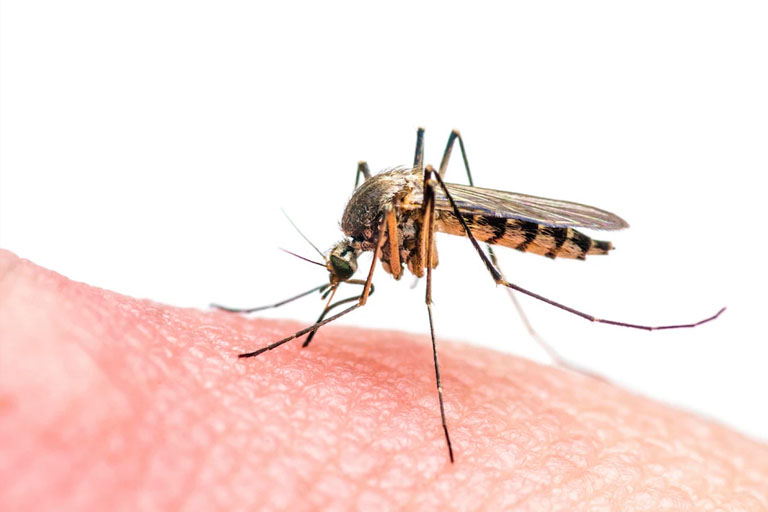
Mosquitoes are members of the order Diptera, ie, flies. Mosquitoes are slender, long legged, two-winged insects that are 1/8 to ½ inch long. They are unlike other flies as their wings and bodies are covered with scales and they have long piercing and sucking mouthparts. The Anopheles Mosquitoes have no scales on their abdomens, as do Aedes or Culex mosquitoυς. They are easily recognized by their mouthparts (ie., two palps and proboscis) which are equal in length, as well as their habit of resting in a straight line at a 45º angle to the surface.
The larvae, or wrigglers, are aquatic with well-developed heads, swollen and unsegmented thoraxes, and eight-segmented abdomens, which usually end in an elongated breathing tube. Anopheles larvae have no elongated breathing tube as do the Andes or Culex mosquitoes, and they have orient themselves parallel to the surface of the water when they are resting or breathing. The pupae, or tumblers, are also aquatic and active, Their heads and thoraxes are encompassed in a large, oval mass with a slender abdomen attached.
Six Anopheles species, Anopheles baimaii, Anopheles culicifacies, Anopheles fluviatilis, Anopheles minimus, Anopheles stephensi, and Anopheles sundaicus are implicated as primary vectors transmitting malaria in different eco-geographical regions of India. Anopheles culicifacies is the major species of malaria transmission mosquito in India. The adults of these species are dark brown, legs dark or with some pale patches, and have dark scales on each wing. They are medium sized, brown mosquitoes with hairy, second body segments which are white in the middle and dark brown on the sides. Anopheles stephensi is another species prevalent in India which has emerged as an urban malaria vector
Biology:
Anopheles mosquitoes form swarms during dusk for mating. Both male and female mosquito feed on nectar for energy. It is only after mating and for the development of the egg’s female mosquitoes feed on blood. For some species one feed of blood is sufficient to lay eggs and for some species second blood feed is required before laying eggs. After the blood meal they stay secluded until they are ready to lay eggs. They lay eggs, which have tiny floats attached to them, singly on the surface of clean. unpolluted water. The eggs hatch in two to six days, with total development taking about two weeks. Under ideal conditions duration of egg to adult may vary 7 days at 31 degree Celsius and 20 days at 20 degree Celsius temperature. Longevity of Anopheles mosquito varies with the temperature and humidity factors. The average lifespan of female anopheles mosquito is about 15 days but there are instances where the lifespan of up to two months reported.
Habitat and Economic Importance:
Anopheles culicifacies is common in India accounting to about 70% of malaria cases in India. The adult mosquitoes breed in ditches, ponds, swamps, and puddles. These mosquitoes are problems in areas where extensive irrigation of crops occurs. They enter structures to feed on humans, but although aggressive, they are not painful biters. They prefer to breed in the sunlit water stagnations.
Anopheles stephensi typical breeding sites are artificial containers, such as domestic wells, cisterns, overhead water tanks, and roof gutters, with clean and unpolluted water allowing rapid expansion to urban environments. The introduction of Anopheles stephensi exhibits resistance to several classes of insecticides, posing challenges in controlling the spread to new areas.
In the summer, mosquitoes become a major nuisance as they seek out humans for blood meals. Most service calls result when a customer plans activities in the backyard, such as an evening party, or there is a problem at the recreational sites. Perennial problems result from mosquito breeding sites located at inaccessible areas of the customer’s premises such as salt marshes, swamps, storage sites, and in other difficult to manage sites, such as city sewers and under structures.
Common Site of Occurrence:
During the rainy season, rain pools and water bodies created by the seasonal Gash River serve as the main breeding sites. In the dry season, irrigation canals, seepage from water pipes, neglected wells, artificial containers, and man-made ditches serve as the main breeding sites. Male adult mosquitoes hide and rest in the shrubs and bushes. Female adult mosquitoes rest in the dark corners and on the vertical objects nearer to the blood source in the households, cattle sheds, indoors in commercial establishments like offices, schools, cinema halls, human transportation vehicles like bus, trains, hospitals etc places.
Management:
It is important to identify the species which is causing the problems as well as the breeding sites. The most common methods of collecting mosquitoes for identification are the use of light traps, siphoning tubes at resting sites, dippers to collect larvae. Light traps can be small and portable or large and permanently wired. Both styles are designed to catch specimens without destroying them on sticky boards or by electrocution. Adults can be collected by using a siphoning jar trap. The best areas for collection during the date are in shady areas, such as inside and on the shady side of sheds and buildings, sewers, culverts, drainage pipes, etc.
Collection of larvae is more labour-intensive because it involves investigation of potential breeding sites which may not be accessible, as well as sampling the site in several locations using a dipper, Lighting around the property can result in problems with mosquitoes. Because lights are beacons for mosquitoes, attraction to the area should be reduced by locating lives away from the structure and directing the mosquitoes towards them. Sodium vapour and/or yellow bug lights should be used instead of incandescent or mercury vapour lights.
Regardless of the species, the key to mosquito control is source reduction, Le, the removal of the water breeding sites. For container breeders, this is usually resolved by site clean-up, However, flood water mosquito problems usually require the use of larvicide. The two most popular larvicides are the insect growth regulator (IGR), Methoprene and the bacteria Bti. Liquid, granules and extended-release formulations are available to treat the site even water are not present. When the product is exposed to water, the active ingredient is released into the water and kills larvae.
Adulticiding with Spraying, aerosol and ultra-low volume products is effective in killing the mosquitoes within the immediate area but does not provide long term control. Residual spraying of mosquito resting sites also reduces the problem. The use of repellents should be considered. Skin repellents, such as DEET and clothing repellents that contain permethrin, are very effective. At their best citronella candles and similar products provide temporary relief. Mosquito problems require considerable customer education because of the diversity of species, their often-remote breeding sites, and the ability of many species to travel long distances,
We Are Authorized Dealers Of..