

Aedes Mosquito
Order/family: Diptera/Culicidae
Scientific Name: Aedes spp.
Mosquitoes are members of the order Diptera, i.e., flies. Mosquitoes are slender, long legged, two-winged insects that are 1/8 to ½ inch long. They are unlike other flies that their wings and bodies are covered with scales, and have long piercing and sucking mouthparts.
The larvae, or wrigglers, are aquatic and have well developed heads, swollen, unsegmented thorax, and eight-segmented abdomens, which end in an elongated breathing tube. The pupae are also aquatic and active. Their heads and thoraxes are encompassed in a large, oval mass with the slender abdomen attached. The most notable species are the yellow fever mosquito (A.aegypti), Asian tiger mosquito (A. albopictus), saltmarsh mosquito (A. sollicitans), and inland floodwater mosquito (A. vexans). The adults of these species are described below:
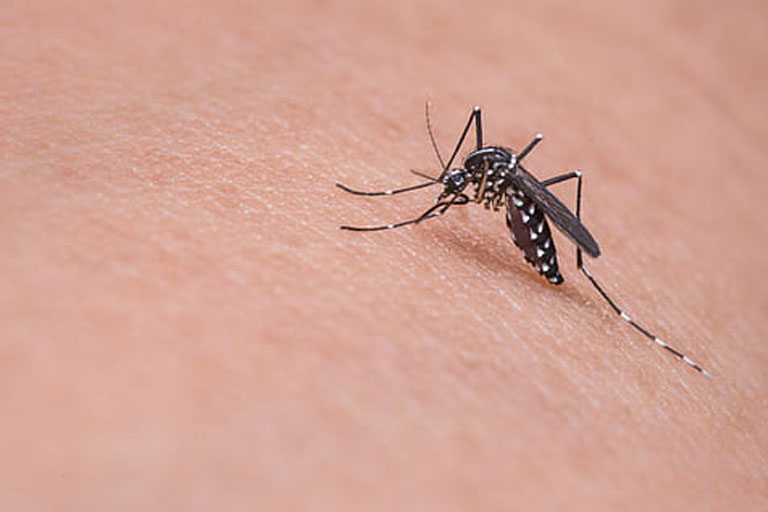
The yellow fever mosquito has silvery white or yellow-white stripes on its black body and a pattern of stripes on the top of its thorax (segments with legs and wings attached) which looks very much like a tuning fork. The last five segments of the legs are banded in white.
The Asian Tiger mosquito has silvery-white markings on its black body, the top of the thorax has a single silver-white stripe down the centre and silver-white bands around the abdominal segments. The last five segments of the legs are banded in white.
The salt marsh mosquito has white bands on the last leg segments and a band across the middle of the mouthparts. The abdomen has bands on most of the segments and a white stripe down the middle of the top of the abdomen.
The inland floodwater mosquito is medium sized and brown with a bad of white scales at the end of each abdominal segment. Each band is notched with a dark “V” that appears to cut it into two pieces. It has very narrow, creamy white to bronze bands on the last five segments of the legs.
Biology:
The eggs, which are laid singly above the water line, hatch when the water rises and contacts the eggs. In the absence of sufficient water, the eggs remain dormant for many years. Mosquitoes undergo complete metamorphosis, i.e., egg, larva, pupa, and adult. The larva and pupa require water for development. Under ideal conditions, these mosquitoes complete their life cycles in ten days.
Common Site of Occurrence:
Aedes Mosquitoes are normally a Day biting insect it would be active in Day time. They breed in the artificial or man made water collections like flower pots, thrown away plastic cups heap, discarded or unused material debris, thrown away tyres, tender coconut shells, construction activities holding water stagnation, uncovered stored water containers, uncovered overhead water tanks. Indoors they rest in a dark areas close proximity of humans.
Habitat and Economic Importance:
Asian tiger and yellow-fever mosquito larvae are found in artificial containers, such as discarded tin cans, tyres, flower containers, in cemeteries, etc. Both species are daytime biters, although the yellow-fever mosquito also bites at dawn and dusk, as do most other species of mosquitoes. In summer, mosquitoes become major nuisances as they seek out your customers for their blood meal. Most service calls result when a customer plans activities in the backyard, such as an evening party, or there is a problem at recreational sites located in inaccessible areas of the customer’s premises, such as swamps, storage sites, and in other sites which are difficult to manage, such as city sewers and under structures.
Management:
The most common methods of collecting mosquitoes for identification are the use of light traps, siphoning tubes at resting sites, and dippers to collect larvae. Both styles are designed to catch specimens without destroying them on sticky boards or by electrocution. Adults can be collected by using a siphoning jar trap. The best areas for collection during the day are in shady areas, such as inside and on the shady side of sheds and buildings, sewers, culverts, drainage pipes, etc.
Lighting around the property can result in problems with mosquitoes. Because lights are beacons for mosquitoes, attraction to the area should be reduced by locating lives away from the structure and directing the mosquitoes towards them. Sodium vapour and/or yellow bug lights should be used instead of incandescent or mercury vapour lights. Regardless of the species, the key to mosquito control is source reduction, i.e., the removal of the water breeding sites. For container breeders, this is usually resolved by site clean-up. The two most popular larvicides are the insect growth regulator (IGR), Methoprene and the bacteria Bti. Liquid, granules and extended-release formulations are available to treat the site even water are not present. When the product is exposed to water, the active ingredient is released into the water and kills larvae.
Aerosol and ultra-low volume products are effective in killing the mosquitoes within the immediate area but does not provide long term control. Resídual spraying of mosquito resting sites also reduces the problem. The use of repellents should be considered. Skin repellents, such as DEET and clothing repellents that contain permethrin, are very effective. Mosquito problems require considerable customer education because of the diversity of species, their often-remote breeding sites, and the ability of many species to travel long distances.
We Are Authorized Dealers Of..