

Subterranean Termites
Order: Isoptera/Rhinotermitidae
Family: Reticulitermes flavipes Kollar – Easter Subterranean Termite.
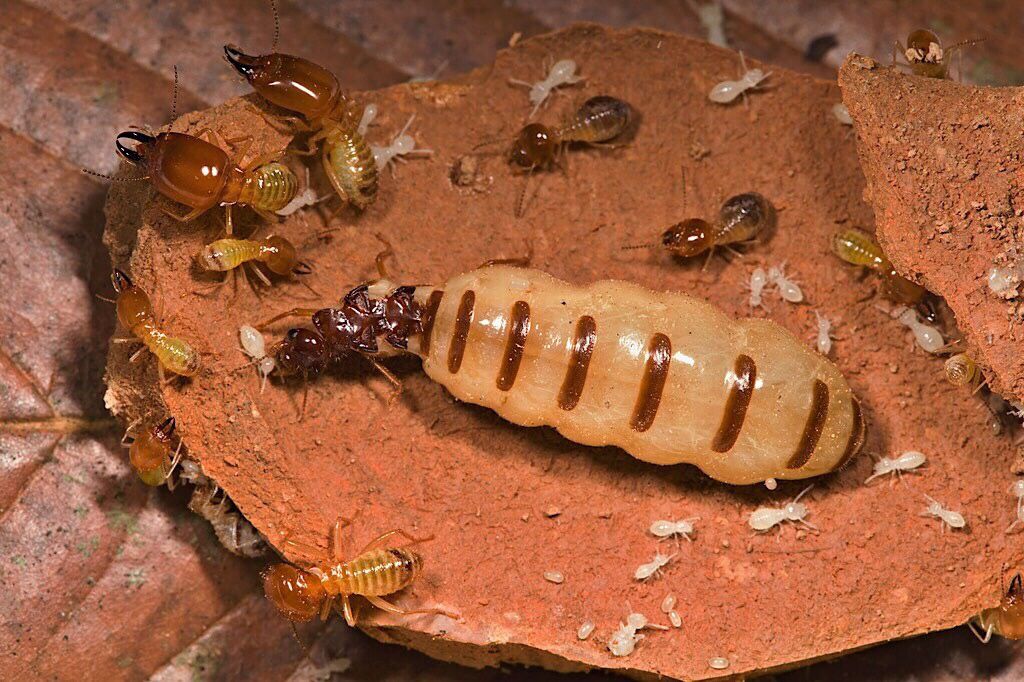
Termites are social insects that live in large colonies. These are three castes: reproductives, workers and soldiers. Termite antennae have bead-like segments. The winged reproductive (swarmer) have a pair of long wings (equal in size) attached to the last two thoracic segments. The wings are broken off after swarming. The abdomen is broadly joined at the thorax, unlike the narrow abdominal attachment found on ants. The winged re-productive are dark brown to almost black and about 3/8 inch long. The wings are brownish grey with few hairs and two dark veins on the leading edge. They have a very small pore on their heads. The soldiers are wingless with white bodies rectangular yellow-brown heads, which are two times longer than their width. And large mandibles which lack teeth.
Biology:
Subterranean termite colonies usually are located in the soil from which the workers build mud tubes to structural wood, where they then feed. Subterranean termite colonies are always connected to the soil and close to a moisture source.
Termites digest cellulose in wood with the aid of special organisms within their digestive system. The worker prefers to feed on fungus-infected wood but readily feed on undamaged wood as well. The foraging workers feed immature workers, reproductive, and soldiers with food materials from mouths and anuses.
A mature queen produces 5000 to 10000 eggs per year. An overage colony consists of 60000 to 250000 individuals, but colonies numbering in the millions are possible. A queen might live for up to 30 years and workers as long as 5 years.
Habitat and Economic Importance:
Subterranean colonies are established by winged reproductive, which usually appear in the spring. Swarms usually occur in the morning after a rain. A male and female that have swarmed from an established colony lose their wings and seek a dark cavity inside which they mate and raise the first group of workers. Both of these reproductives feed on wood, tend the eggs, and build the initial nest.
After the workers mature, they take over expanding the colony and feeding the reproductive As the colony becomes larger, light coloured supplementary reproductive are produced to lay eggs which then become workers. The soldiers, which are also produced as the colony increases in size, are responsible for repelling invading ants and other predators.
We Are Authorized Dealers Of..