

German Cockroach
Order/family: Blattodea/ Blattidae
Scientific Name: Blattella Germanica
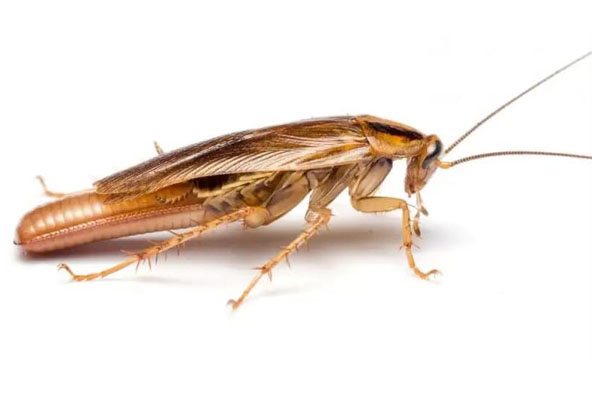
German cockroaches are ½ to 5/8 inches long when mature, G light brown to tan and have fully developed wings. The pronotum has two dark parallel bars on it. The adult males are somewhat narrower than the females when viewed from below. The nymphs, 1/8 inch long when they emerge from the capsule, are almost uniformly dark except for a light tan area on the back of the second and third segments. As they develop, the light tan area becomes larger until, as mature names, they have two parallel black bars separated by a light area. The purse-shaped egg capsule of the German cockroach is light brown in colour, ¼ to 3/8 inch long and typically has 15 to 20 eggs per site.
Biology:
During the lifetime, female German cockroach produces 4 to 8 eggs capsules, each of which contains 30 to 40 eggs. The female carries the egg capsule partially within her abdomen until just before the nymphs are ready to emerge. Approximately one to two days before hatching, she drops the egg capsule in a protected area. If the egg capsule is dropped prematurely, the developing roaches inside die of dehydration. Nymphs moult six to seven times before becoming adults. This requires about 103 days; Thus allowing 3 to 4 generations per year. Adults live 100 to 200 days. The established German cockroach population consist of approximately 75% nymph.
Habitat and Economic Importance:
German cockroaches are the most common household insect. These typically infects kitchens and bathrooms but will live anywhere inside heated structures in which there is food, water and harbourage. They are rarely found outdoors and then only during warm weather. German cockroaches gain entry into structures in grocery bags, cardboard boxes, drink cartons, equipment such as moved refrigerators, toasters, and microwaves, etc. Cockroaches feed on all types of human food, as well as pet food, toothpaste, soap, glue, etc. German cockroaches are active at night, leaving their harbourage to find food and water. They remain hidden in the dark, secluded harborage areas, for example, under cupboards, behind cabinets, in wall voids and around motor housings in appliances where they spend 75% of their time. At most, only one third of the population forages at night. Observation of foraging cockroaches during the day is a good indication that there is a tremendous population. Cockroaches congregate in harbourage sites: But as the population increases, overcrowding forces some of them to relocate.
Common Site of Occurrence:
German cockroaches are the most common species of cockroaches found in the households and commercial establishments in India.
They have the ability to live anywhere where they get food water and harbourage but are most commonly found in the Kitchens or the locations where the food and food materials are stored.
Major source of entry of German Cockroaches into the buildings / establishments / household is through grocery bags, cardboard boxes, electrical equipment’s like refrigerators, microwave ovens if infested or any other kind of materials movement. You can find them in household kitchen, refrigerators, storage cupboards, Restaurant kitchens, Hotel Kitchens, Bathrooms, Hospitals storage cupboards, canteens, offices storage areas, educational institution storage areas, retails racks, storages etc locations.
Management:
Because German cockroaches are typically brought into structures, potentially infested products should be closely inspected Cockroach Monitoring Traps are available to help pinpoint sources of cockroach infestation and to monitor areas about which occupants have complained about infestations but cannot visually be detected. Sticky traps are not intended for control but rather to guide and evaluate control efforts as part of the inspection process. Visual inspections can be conducted using a flashlight and flushing insecticides like pyrethroids or propoxur can be used as sprays to flush cockroaches from their harbourages.
An effective cockroach management program depends on good sanitation to eliminate the food, water, and harbourage they need for survival. Clean-up to reduce cockroaches in the home and office environments must focus mainly on the residue in and around coffee machines, microwave ovens, stores, refrigerators, trash cans, furniture, and areas where exposed food is stored. In addition, it is critical to reduce clutter as cockroaches like to hide in stock boxes, cartoons and stored paper and cardboard materials, especially in dark, damp locations near food.
Vacuum cleaning can be used to physically remove exposed cockroaches. Infested equipment may have to be disassembled and may have to be treated for complete population removal before further use. Permanent reduction of cockroach population can be achieved by sealing gaps/crevices to eliminate harborage. The most important cracks to eliminate include those at which sinks and fixtures are mounted, around crown molding hand corner guards, and where shelves and cabinets meet walls and door frames.
Containerized paste, dry and Gel baits have become very popular in the industry and are very effective products for managing cockroaches. To maximize effectiveness, paste, gel and dry baits should be applied with a syringe like dispensing tool in many small tabs or sports that are close to harbourage sites. Large, plastic bait containers should be placed as close as possible to the dark concealed spots where cockroaches are living, preferably adjacent to edges and corners.
We Are Authorized Dealers Of..